Friday, April 20, 2007

Cellar Door

"Most English-speaking people...will admit that cellar door is 'beautiful', especially if dissociated from its sense (and from its spelling). More beautiful than, say, sky, and far more beautiful than beautiful. Well then, in Welsh for me cellar doors are extraordinarily frequent, and moving to the higher dimension, the words in which there is pleasure in the contemplation of the association of form and sense are abundant."

-- J.R.R Tolkien via wikipedia

Today we did not make a cellar door but we did make something nearly as beautiful in essence. We finished off the end of the greenhouse, and built and hung two eight foot doors. Quite grand an achievement. It consumed about 40 person hours of work (at most), and plenty of lumber. But the result is that the second half of the greenhouse can be used now to grow tomatoes.

Again, I iterate that it is immensely satisfying to pretend to be a carpenter. The aesthetics of working with wood, saws, pencils, and screws is enormous. Especially when it gets to be around four in the afternoon and the day is cooling off slightly, and the earth and wood and trees are lit up with the slanting golden light. It's pretty easy to feel like a king, I say.

Then there's the fact of actually constructing something physical. It's a bit of the same enjoyment I get from writing computer programs, only there's a different flavour with this. Maybe partly because it's a fairly new experience for me... it's like programming with a new language, or maybe like working with databases or threads for the first time. I'm exploring an new terrain and that's inherently exciting. Construction is also incredibly fun because I'm reasonable good at it -- working the numbers, and the designs come naturally enough -- so I'm able to move at a decent pace. And that keeps me entertained.

There wasn't much work in the greenhouse today. Ali and Leslie trimmed the onions because they were getting a bit long and floppy. Trimming them (about three centimetres, or until they stand about ten centimetres) is supposed to cause the seedling to put more energy into root and stem growth rather than continuing to grow upwards. The result is a heartier seedling that is more prepared for transplanting and the outdoors.

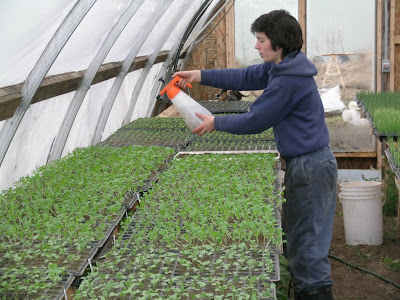
We also did a second spraying of the horsetail mixture I mentioned before. Leslie noticed some "dampening off" on some of the broccoli and other brassica family members. Dampening off is a condition where the young seedlings just flop over and die. It's often due to a fungus that grows on the soil because it is too moist. It's part of the reason we installed the fan -- greater air movement means less chance of parts of the greenhouse becoming damp -- and also why we first sprayed the horsetail mixture.

Thursday, April 19, 2007

No carpenter

I ain't no carpenter, but it sure is fun to pretend. We all spent the day tearing down and then rebuilding one end of the greenhouse. We're not quite done yet, but we've got most of the foundational bits done. I'll post some pictures of it.

The old adage "measure twice, cut once" is certainly an important and useful one. I'd probably add a footnote about how a redoing all your work twice saves you from sketching a quick diagram ahead of time. Here's another piece of advice. Never force a window into place, unless you like increasing the probability of laceration in your locality. Also, after two near misses of a falling 4x4 beam I've discovered why construction workers wear hardhats.

Wednesday, April 18, 2007

Clean up, Tables, and Cover Crops

Two days to catch up on.

Yesterday's Activities

Spent the day cleaning up the shed again. This time it was Jarrod, Jeff, and I working together. We did heaps. We organised all the tools, moved a few work benches around, and ran power to the tools benches. We also started work on cleaning up a beast of an old work table with hopes that we can resurface it to use it as our 'harvest table' (i.e. the one we stand around while sorting and bunching the vegetables just harvested).

Today's Activities

Shortened the legs of a harvest table and put wheels on it so that we can move it around easily enough. Did a bit more clean up in the shed, and built a coat rack and boot rack. The rest of the day was spent inside.

I called around to find out what to use on the surface of the table. Since we're planning to be washing it down daily and working with food on it, we'll probably need something sturdy and sanitary. The two choices we seem to have come down to are stainless steel or an acrylic top. Both options are very expensive.

Anyhow, after that we watched a video on cover crops, and had a discussion. I'll have to explain more about that later.

Monday, April 16, 2007

Still cleaning...

Today's activities:
  • Seeded several trays of lettuce, fennel, flowers and tomatoes.
  • Collected maple sap for the last time. The sap is flowing pretty regularly but it's been consistently cloudy for the past while, and the sap from certain trees tastes very... green. And by that I mean, much like how willow or grass tastes green. When the sap runs clear it tastes pretty watery and plain.
  • Spent a long while with Jeff scratching the top layer of fungus laden soil off of the onion trays. The fungus appears either dark green, really dark green, or orange (when it has dried out), and makes the top 1-2mm of soil stick together and resist water. Scratching it off often reveals quite dry soil underneath which is a big problem if you're a... you know... water gulping seedling.
  • Lunch.
  • Met with the Jeff, Leslie, Ali, and Jarrod out in the barn by the new piglets that were born Saturday morning. This is to be a regular meeting time to discuss any issues. The only real issue was sorting out that Jarrod would no longer be doing chores (feeding the cows and pigs, milking, mucking out the milking area, watering the chickens, and collecting eggs), and that I'd start doing that for a bit in order to get the hang of it.
  • The rest of the afternoon Jeff and I worked on cleaning up the disaster area that is the main shed. Part of this shed will eventually be used as space to process (wash, sort, and bunch) the produce from the fields.
Watching the piglets was a bit of a mixed experience. They are pretty adorable creatures. About the size of a loaf of bread (and with similar proportions), these eight little dudes spent most of the time clambering to find a nipple, or sleeping for 20 seconds at a time by resting their heads on another feeding sibling. The mother, the size of a small sofa, just lay on her side grunting occasionally and snuffling distractedly.

Actually, one piglet was away from the action, right by the mothers head, laying on its side and obviously dying. How so? It had glassy eyes and twitchy breathing and was occasionally pawing around at the air in a pathetic way. Over the course of our meeting I watched it slowly become less and less active until eventually its mouth hung open and it wasn't moving really. Between you and me, I silently repeated a little prayer for it. Maybe we'll meet up on its next go 'round, or mine.

I checked back just before I left and discovered a bit of gruesomeness. There were now only six piglets feeding (originally there were seven plus the sickly one). There was one piglet which was dead and only the remains of another piglet (just the ear and a bit of something). So it goes. I was told that the male pigs are kept away from a new litter because they'll occasionally eat the young ones but, as I found out today, in some cases so will the mother.

Sunday, April 15, 2007

Transplanting Celery and the Optimal Potato Sort

Today's Activities:
  • Spent the morning sorting potatoes. We managed to finish sorting all the potatoes in storage.

  • Lunch.

  • Transplanted celery seedlings. This is a cool process, and requires dexterity and lots patiences. The idea is this. Celery seeds apparently germinate better when they are together, rather than separated into individual cells in a tray. So, you "broadcast" (i.e. sprinkle, toss, spread, etc...) the celery seed into a tray of soil and let it sprout. Wait until it looks like so:


    Then you transplant a seedling from this mess of stuff into cells. That is, you grab a clump of seedling-laden soil, carefully break it apart so that you can extract individual sprouts, like this:


    And then place them each into a holes you've made with, say a pen, in the tray.


    Easy enough, but a bit painstaking. Something I couldn't imagine Annemarie putting up with. ;)

    We planted a total of 8 trays of celery, and 8 trays of chard (I think. I double check these numbers). For chard, one seed is placed directly into each cell.

  • The rest of the day was spent doing random clean up jobs. Sweeping and tidying the farm store and another storage room; disposing of rotten potatoes leftover from the sorting process; etc..


A note about potato sorting. Now that it's over I think I can comment a little on the optimal sorting algorithm. Typically the goal is to sort the potatoes into three categories: those for sale, those for seeding, and those that are rubbish. A potato is deemed "saleable" if it is larger than, say, your average clementine. Otherwise it's probably best suited for seed.

In either case, if the potato is squishy, liquid, or smells like shit (I mean, actual shit), then it belongs in the rubbish pile. Also, sometimes we'd sort a crate of mixed white and red potatoes, in which case there's the additional task of separating the seed potatoes into reds and whites. Anyhow, the quickest and most entertaining sorting method I came up with goes something like this:

while (more potatoes to sort) {
  pick out smelly and rotten potatoes;
  pick out all saleable potatoes in plain view;

  while (more seed potatoes in plain view) {
    pick out all red seed potatoes;
    pick out all white seed potatoes;
  }

  dig around a bit to uncover more potatoes;
}


This method is miles ahead of some of the other ones I saw people practicing. In particular, here's a terrible method:

while (more potatoes to sort) {
  pick up a handful of potatoes;

  for each potato in the handful {
    put it in the appropriate bin;
  }

  dig around a bit to uncover more potatoes;
}

This method is far far too slow. You end up day dreaming about Tuscaloosa or something silly like that while your one hand travels to and from the other hand to the different bins. It's also, as you can tell, bottle-necked by the one-handedness of the sort, whereas the optimal method allows both hands to work independently (which, incidentally, is quite an awesome feeling).

One last thing. It turns out that there is a nasty potato-size grey area that makes high-speed categorisation decisions kinda nerve-racking. Typically what happens is that you consistently end up ignoring these ambiguous potatoes until they clutter your view so much that you're forced to deal with them in order to continue. Here's a version of the optimal potato sorting algorithm to work around this problem:

while (more potatoes to sort) {
  pick out smelly or rotten potatoes;
  pick out all saleable potatoes in plain view;

  while (more seed potatoes in plain view) {
    pick out all red seed potatoes;
    pick out all white seed potatoes;
  }

  push remaining potatoes into neighbour's sort area;

  dig around a bit to uncover more potatoes;
}

Thursday, April 12, 2007

Today's activities:
  • Sifted composted for an hour or two
  • Moved the fan in the greenhouse to a new position because it seemed to be drawing in cool air from the unheated section of the greenhouse:
  • Sorted lots of potatoes.
  • Collected maple sap.
Leslie made a concoction to spray on the seedlings to help with a pale green fungus that seems to be building up on soil. She boiled horsetail for a while and got this:


A bottle of goo. She then mixed this 1:9 with water. This is a Biodynamic preparation, and has to be stirred for twenty minutes (more on this in a later post). After the stirring the preparation is sprayed on the seedlings. Here's Ali in on the action:


Wednesday, April 11, 2007

Clean up

Up until a moment ago I felt incredibly wide awake. I've felt this way all day. It could be because today was such a good and solid day of work. Nothing punishing, just a consistent going-down-the-checklist sort of day. The sort of day where if it were a race your grade 8 gym teach would describe it as a "strong finish".

The days event's, in order:
  • Cleaned up unheated section of the greenhouse to prep it for seeding.
  • Hauled burnable wood rubbish from around the greenhouse to the burning heap.
  • Hung a fan in the heated section of the greenhouse in hopes that the increased circulation will remove some of the condensation.
  • Sifted composed as prep for making potting mix.
  • Lunch.
  • Graded carrots in storage into those we can sell, those so gnarly or misshapen that they can only be used in our kitchen, and those so grossly malformed or rotted that only the cows can be convinced of eating them.
  • Graded red potatoes by size into seed potatoes (smallish) and for washing and further grading. Here's Jarrod and our current WWOOFer (who's name I won't attempt to spell out here) in the midst of this activity:

  • Washed a few crates of carrots and potatoes for the farm store.
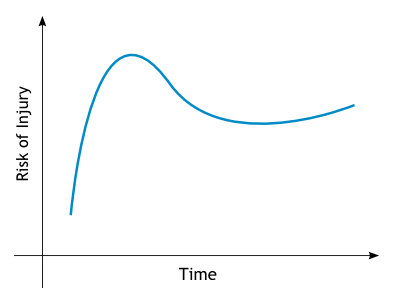
I'm really aware of my back these days. Having not done much lifting or twisting and such for a year or so now I'm acutely conscious of overdoing it. I think there's a certain way in which risk of injury changes over time. A familiar story, I think it's something like this:

I'm somewhere to the left of the hump at the moment... I'm pretty fresh and enthusiastic, and it's that momentum that could probably carry me through a few spine-seizingly dangerous heroics in the short term. Soon enough though I suspect I'll reach a local maximum of risk of injury as my body finally succumbs to the strain of things. If I make it through that the risk should ease up a bit as my muscles and joints and behaviours adapt to the day-to-day work.