Alrighty here, another few days to recap.
Last Thursay and Friday were spent doing similar things. Jarrod, Jeff, Amanda and I spent most of the days constructing an insulated room within the existing coolroom. The idea being that since the existing coolroom is massive and not air conditioned (it's cooled with sensible opening and closing of the main door throughout the cooler months only) but still insulated we could build two walls and a door and suddenly have our own reasonably sized room to store vegetables. And we could use a hacked window air conditioner I mentioned before to cool it.
We managed to build most of it, less the door. As before, it was a lot of fun to pretend to be a carpenter. I also spent some time calling around to electricians and appliance repair folk to see if anyone could give me advice on how to hack the air conditioner and how exhaust the heat. Eventually I found most of what I think I need to know from my friend Shaun over at Fidalia Networks Inc. who has a ton of experience with refrigerating server rooms.
Saturday was another learning day, and this time we had a talk by my roommate Tarrah on soil. A really fantastic talk. We learnt about the origin of soil, soil composition, the mineral composition of soil, soil structure, and soil life. All of what could be was applied as Tarrah had us out in the fields all morning digging holes and inspecting our soil.
Did I ever mention that I wanted to start a list of organic farming axioms? Well, regardless, Tarrah's workshop highlighted the axiom, "Feed the soil, not the plants". That is, rather than dump liquid fertiliser on the soil intending for the plants to soak it up before the next rain (where it'll get washed away into the rivers and ground water) instead, intelligently rotate crops, apply compost, or other amendments and practices designed to encourage healthy soil life which will make the existing nutrients in the soil available to the plants.
Anyhow, yesterday we spent the morning planting strawberries (just in the home garden), making soil mix, and getting the seed potatoes ready for planting. The afternoon was a frenzy of hoeing and floating row cover moving. Five hours later, and we had de-weeded the entire brassica planting. This was such a dusty job... when I took a shower last night the water ran silty brown for a minute or so.
Showing posts with label potatoes. Show all posts
Showing posts with label potatoes. Show all posts
Tuesday, May 22, 2007

Sunday, April 15, 2007
Transplanting Celery and the Optimal Potato Sort
Today's Activities:
A note about potato sorting. Now that it's over I think I can comment a little on the optimal sorting algorithm. Typically the goal is to sort the potatoes into three categories: those for sale, those for seeding, and those that are rubbish. A potato is deemed "saleable" if it is larger than, say, your average clementine. Otherwise it's probably best suited for seed.
In either case, if the potato is squishy, liquid, or smells like shit (I mean, actual shit), then it belongs in the rubbish pile. Also, sometimes we'd sort a crate of mixed white and red potatoes, in which case there's the additional task of separating the seed potatoes into reds and whites. Anyhow, the quickest and most entertaining sorting method I came up with goes something like this:
This method is miles ahead of some of the other ones I saw people practicing. In particular, here's a terrible method:
This method is far far too slow. You end up day dreaming about Tuscaloosa or something silly like that while your one hand travels to and from the other hand to the different bins. It's also, as you can tell, bottle-necked by the one-handedness of the sort, whereas the optimal method allows both hands to work independently (which, incidentally, is quite an awesome feeling).
One last thing. It turns out that there is a nasty potato-size grey area that makes high-speed categorisation decisions kinda nerve-racking. Typically what happens is that you consistently end up ignoring these ambiguous potatoes until they clutter your view so much that you're forced to deal with them in order to continue. Here's a version of the optimal potato sorting algorithm to work around this problem:
- Spent the morning sorting potatoes. We managed to finish sorting all the potatoes in storage.
- Lunch.
- Transplanted celery seedlings. This is a cool process, and requires dexterity and lots patiences. The idea is this. Celery seeds apparently germinate better when they are together, rather than separated into individual cells in a tray. So, you "broadcast" (i.e. sprinkle, toss, spread, etc...) the celery seed into a tray of soil and let it sprout. Wait until it looks like so:

Then you transplant a seedling from this mess of stuff into cells. That is, you grab a clump of seedling-laden soil, carefully break it apart so that you can extract individual sprouts, like this:
And then place them each into a holes you've made with, say a pen, in the tray.
Easy enough, but a bit painstaking. Something I couldn't imagine Annemarie putting up with. ;)
We planted a total of 8 trays of celery, and 8 trays of chard (I think. I double check these numbers). For chard, one seed is placed directly into each cell. - The rest of the day was spent doing random clean up jobs. Sweeping and tidying the farm store and another storage room; disposing of rotten potatoes leftover from the sorting process; etc..


A note about potato sorting. Now that it's over I think I can comment a little on the optimal sorting algorithm. Typically the goal is to sort the potatoes into three categories: those for sale, those for seeding, and those that are rubbish. A potato is deemed "saleable" if it is larger than, say, your average clementine. Otherwise it's probably best suited for seed.
In either case, if the potato is squishy, liquid, or smells like shit (I mean, actual shit), then it belongs in the rubbish pile. Also, sometimes we'd sort a crate of mixed white and red potatoes, in which case there's the additional task of separating the seed potatoes into reds and whites. Anyhow, the quickest and most entertaining sorting method I came up with goes something like this:
while (more potatoes to sort) {
pick out smelly and rotten potatoes;
pick out all saleable potatoes in plain view;
while (more seed potatoes in plain view) {
pick out all red seed potatoes;
pick out all white seed potatoes;
}
dig around a bit to uncover more potatoes;
}
This method is miles ahead of some of the other ones I saw people practicing. In particular, here's a terrible method:
while (more potatoes to sort) {
pick up a handful of potatoes;
for each potato in the handful {
put it in the appropriate bin;
}
dig around a bit to uncover more potatoes;
}
This method is far far too slow. You end up day dreaming about Tuscaloosa or something silly like that while your one hand travels to and from the other hand to the different bins. It's also, as you can tell, bottle-necked by the one-handedness of the sort, whereas the optimal method allows both hands to work independently (which, incidentally, is quite an awesome feeling).
One last thing. It turns out that there is a nasty potato-size grey area that makes high-speed categorisation decisions kinda nerve-racking. Typically what happens is that you consistently end up ignoring these ambiguous potatoes until they clutter your view so much that you're forced to deal with them in order to continue. Here's a version of the optimal potato sorting algorithm to work around this problem:
while (more potatoes to sort) {
pick out smelly or rotten potatoes;
pick out all saleable potatoes in plain view;
while (more seed potatoes in plain view) {
pick out all red seed potatoes;
pick out all white seed potatoes;
}
push remaining potatoes into neighbour's sort area;
dig around a bit to uncover more potatoes;
}
Wednesday, April 11, 2007
Clean up
Up until a moment ago I felt incredibly wide awake. I've felt this way all day. It could be because today was such a good and solid day of work. Nothing punishing, just a consistent going-down-the-checklist sort of day. The sort of day where if it were a race your grade 8 gym teach would describe it as a "strong finish".
The days event's, in order:
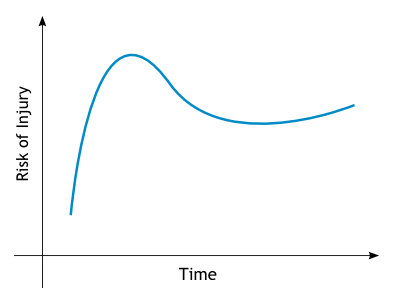
I'm somewhere to the left of the hump at the moment... I'm pretty fresh and enthusiastic, and it's that momentum that could probably carry me through a few spine-seizingly dangerous heroics in the short term. Soon enough though I suspect I'll reach a local maximum of risk of injury as my body finally succumbs to the strain of things. If I make it through that the risk should ease up a bit as my muscles and joints and behaviours adapt to the day-to-day work.
The days event's, in order:
- Cleaned up unheated section of the greenhouse to prep it for seeding.
- Hauled burnable wood rubbish from around the greenhouse to the burning heap.
- Hung a fan in the heated section of the greenhouse in hopes that the increased circulation will remove some of the condensation.
- Sifted composed as prep for making potting mix.
- Lunch.
- Graded carrots in storage into those we can sell, those so gnarly or misshapen that they can only be used in our kitchen, and those so grossly malformed or rotted that only the cows can be convinced of eating them.
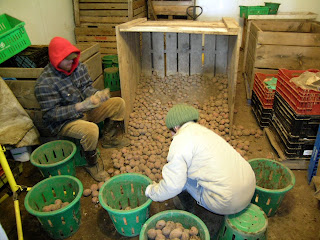
- Graded red potatoes by size into seed potatoes (smallish) and for washing and further grading. Here's Jarrod and our current WWOOFer (who's name I won't attempt to spell out here) in the midst of this activity:
- Washed a few crates of carrots and potatoes for the farm store.

I'm somewhere to the left of the hump at the moment... I'm pretty fresh and enthusiastic, and it's that momentum that could probably carry me through a few spine-seizingly dangerous heroics in the short term. Soon enough though I suspect I'll reach a local maximum of risk of injury as my body finally succumbs to the strain of things. If I make it through that the risk should ease up a bit as my muscles and joints and behaviours adapt to the day-to-day work.
Subscribe to:
Posts (Atom)